Osprey fascinate me. I’ve been following a nesting pair along the Willamette River near Independence, Oregon for a while now, watching as they hunt fish, fend off eagles, and fly with twigs twice the length of their body to build fortified nests.
In the case of osprey, these nests are usually on top of snags, or on man-made platforms designed specifically for this purpose. While most birds prefer siting their nest in places that provide a degree of camouflage and cover, osprey prefer to be out in the open, which explains the preference for snags and platforms.
This might seem counterintuitive as the nest is completely exposed to predators and the elements. It was as if the nest advertised itself to hungry eagles and hawks looking for some breakfast huevos. Then I tried to imagine how the osprey might view this and wondered what advantages there might be to their strategy. Visibility? There sure was plenty of that! Defensibility? Must be. Ideally, one bird would remain in the nest or close by while the other was out hunting, making any nest raiders instantly regret their choice.
Osprey mates are also good at communicating their locations and danger to each other. I would hear the peeps of a male out hunting to reassure its mate back near the nest. And if a hawk or eagle flew into the area, the peeping would grow more rapid in alarm. Eagles are especially feared aerial thieves who often try to scare osprey into dropping their catch. One afternoon I saw an osprey attack an eagle who’d been flying nearby. In the photo I grabbed, it looks like a male osprey and a female eagle.
Another remarkable thing about osprey is their exclusively fresh fish diet. Unlike other raptors, osprey generally eat only fish they’ve caught. You won’t find them chasing rodents or nibbling at roadkill. On occasion, they might take a snake, but it’s a rare occurence. These birds are the avian world’s supreme fish hunters, their vision adapted to see fish in the water from over 100 feet in the air. Not only that, as they dive from such heights, they adjust the angle of approach to account for the refraction of the water. Other adaptations include outer talons that are reversible, kind of like our human thumbs, providing a better grip on their prey. They also have backward facing scales on their talons that act like barbs to further improve their grip on slimy fish.
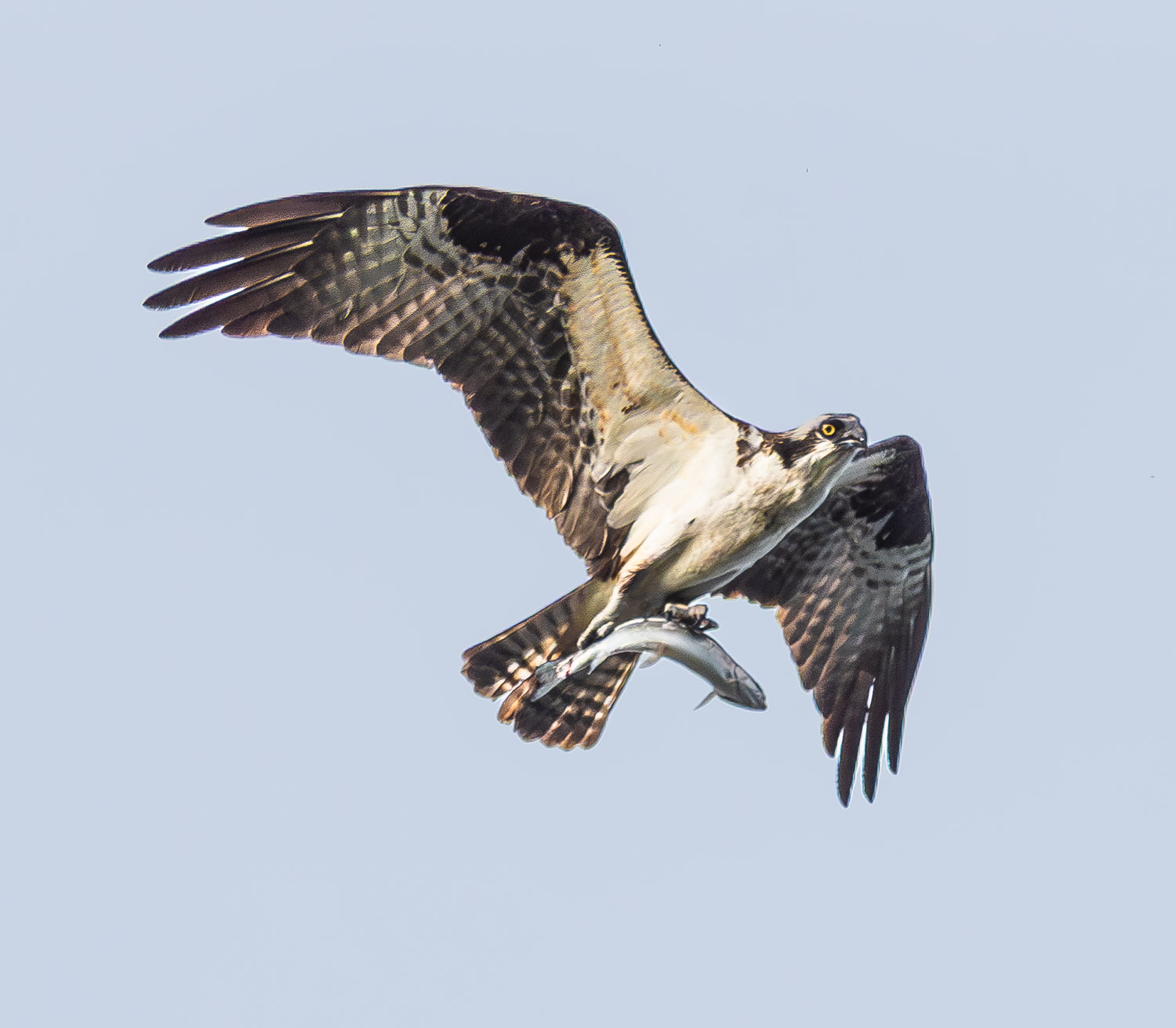
I was lucky enough to snap the male osprey in the air after it caught a fish. Another remarkable trait of the osprey is that it ‘orients’ its catch so that the head of the fish faces forward while flying. Somehow, the osprey has figured out that this offers an aerodynamic advantage. This ‘head-first’ position has an additional advantage: when the bird lands on a branch with its catch, the fish is heads-up and the head is the best part of the fish — for an osprey.
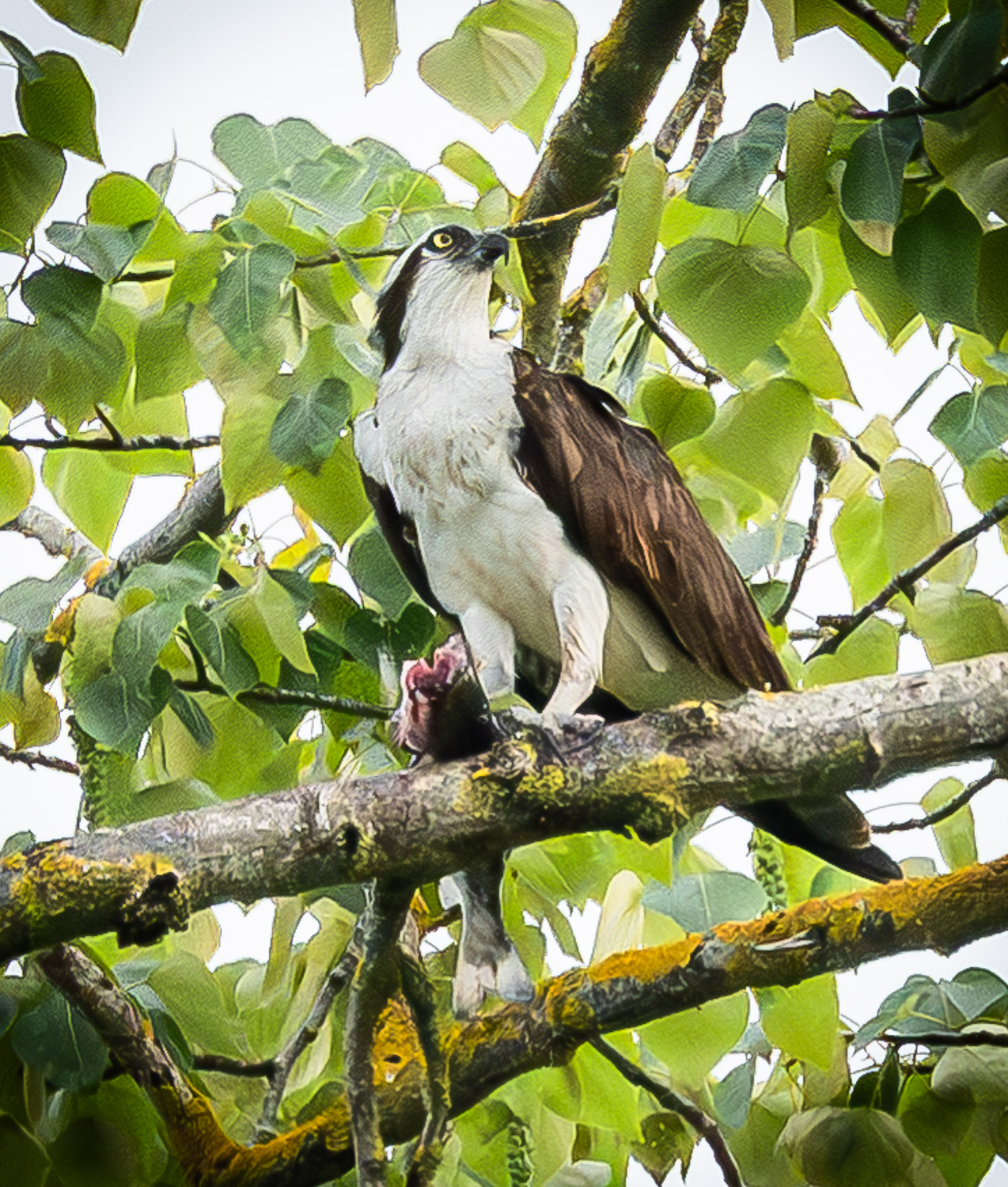
I captured this behavior as seen in the photo here. The osprey chomped at the fish’s head, pecking it right down to the gills. I learned that osprey typically started with the head as it was the most nutritious part of the fish. The brains, eyes, etc. were a wealth of protein that the successful hunter got to enjoy before sharing the rest of the fish. Once again, the osprey had figured this out and decided the head was its just reward for such hard work.