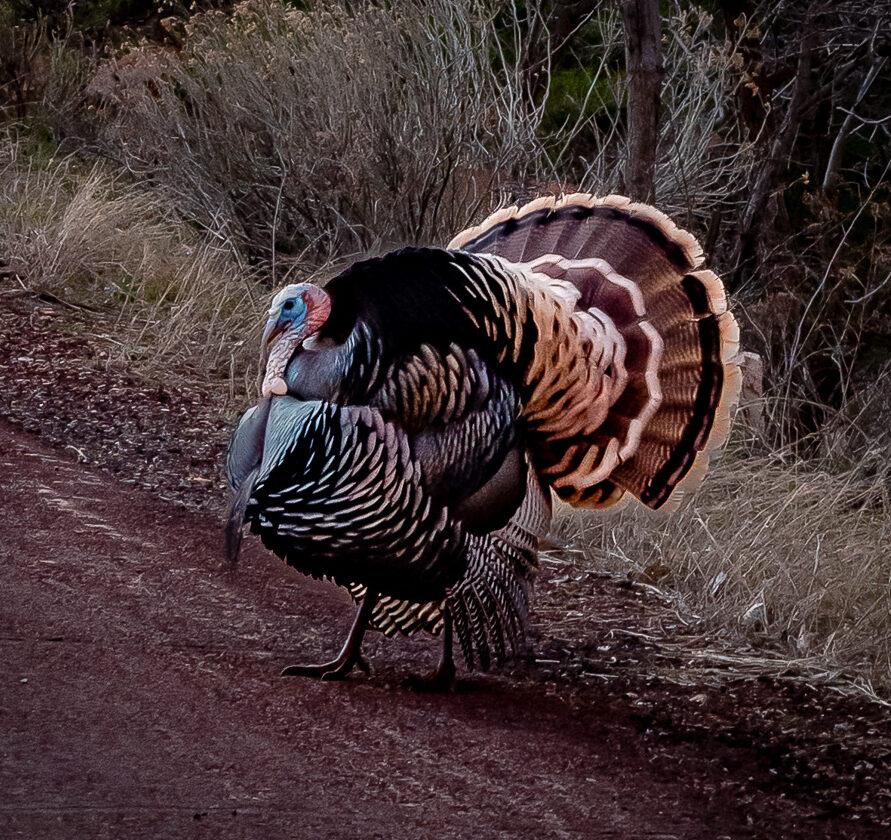
Some birds fly and some don’t. Like the Tom Turkey I snapped in Zion National Park. Like other flightless birds, male turkeys strut and posture with colorful displays and distinct calls to attract females. Monogamy isn’t part of the male turkeys’ play book.
Some species of flying birds have similar male slackers like the terrestrial bound turkey, and something in their hard-wiring saw an evolutionary advantage in this long ago. And then there are the rugged loners, big raptors like the American Bald Eagle and North American Osprey, who mate for life. This is even more incredible when you consider migratory hunters like the osprey. These birds migrate solo, flying thousands of miles alone, yet always return to the same nesting grounds year after year, to reunite with their mate.
It’s easy to put a romantic human spin on this kind of behavior. After all, such dedication is rarely found in Homo sapiens! It seems epic to us and rightly so. But is there ’emotion’ involved in any of it? Or is this just a pragmatic evolutionary strategy driven on some cellular level? Science will give you one answer, fair enough. On the other hand, the idea of animals having an emotional reality that we aren’t privy to doesn’t seem all that far-fetched to me. If you’ve ever had animals in your life, you know this.
So, who knows what drives such fealty? These large raptors have little to fear as they’re the ‘lions’ of the aves. Has that confident position allowed them to develop what we might call feelings? Love, even? Or is it mainly biochemical signals stirring in DNA? Who knows? As Hamlet said, ‘There are more things in heaven and earth than are dreamt of in your philosophy.’